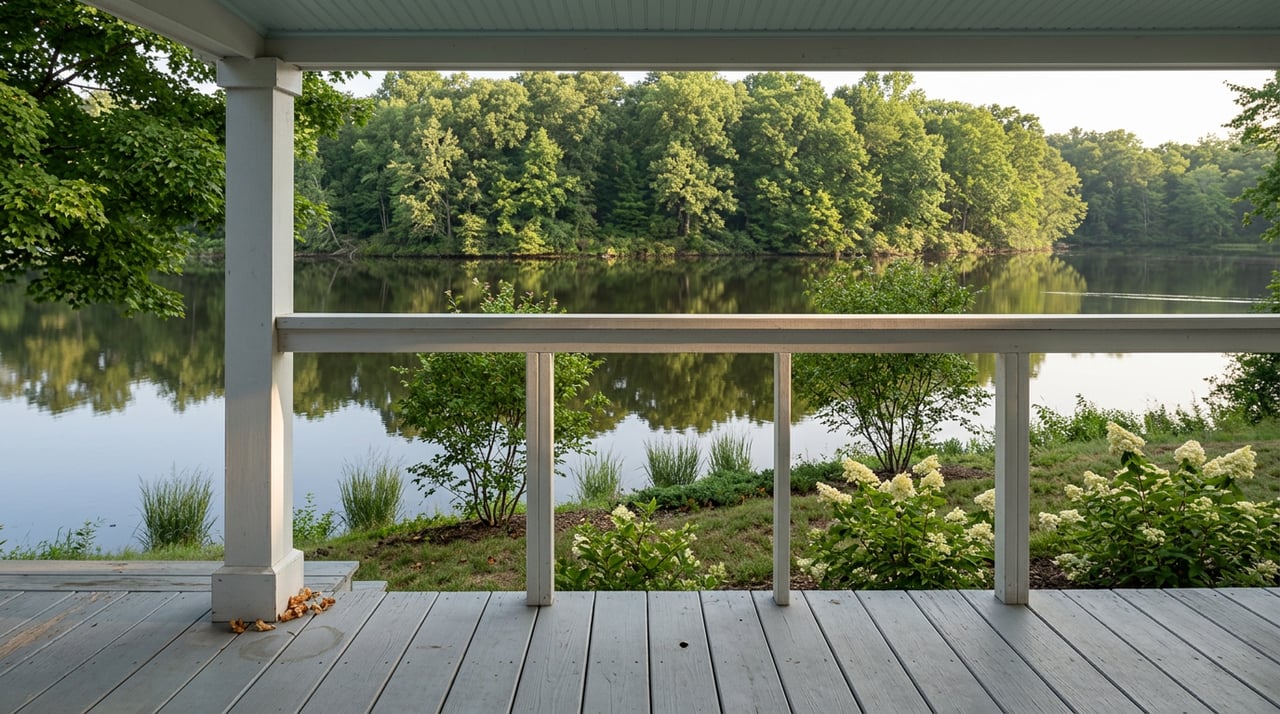
Most buyers walking into a Leelanau County waterfront transaction assume the pace is set by the usual suspects: appraisal turn times, the inspection period, the underwriter's conditions. On a Lake Michigan bluff parcel or a North Lake Leelanau cottage, those are the easy pieces. The variables that actually move a closing date sit outside the purchase agreement entirely, held by a health department in Benzie County and a state environmental agency in Lansing.
That reality is why the county's headline median is a poor guide to what a waterfront deal looks like right now. The number a portal shows you and the number you negotiate against are drifting apart.
The thesis. In Leelanau County today, the closing timeline on a waterfront or rural property is set by two permit clocks that begin outside the purchase agreement, and the county median hides a two-track market in which shoreline stock trades to a very different tape than the inland average.
The number that hides the deal you're actually in
Look at the mid-year 2026 numbers together. First-half sales rose to 151 homes, up from 130 in the same window of 2025. Total volume climbed from $110.4 million to $141.6 million. The average sale price crossed $937,506, up more than ten percent year over year. The median, though, slipped to $640,000 from $662,500.
Averages rising while the median falls is a mix-shift story. The high end is doing more of the work. That reads directly against Grand Traverse County's mid-year median of $420,000 and against the Leelanau luxury inventory, where a third of the market has historically sat above $1 million per a Northern Express feature on the county's luxury tier.
The practical consequence is that a Leelanau waterfront listing is not priced against the county median. Kimberly Bork of Venture Properties has publicly described Leland as a balanced market with roughly five months of inventory, which is the softer of the two tracks. Bluff-front and inland-lake product on North Lake Leelanau and West Grand Traverse Bay is a different conversation, and it moves on a different clock. Buyers who anchor to the $640,000 median walk into offers that feel irrational. They aren't. They're priced to a subset the median never contained.
Friction one: the BLDHD clock starts before the contract does
Michigan has no statewide sanitary code. That gap is why northern Michigan's local ordinances matter more than sellers moving in from other states expect. On January 27, 2023, the Benzie-Leelanau District Health Department put a Time of Transfer rule into force across both counties. Any Leelanau property with an on-site well or septic system must be evaluated by BLDHD before it can be transferred to a new owner, including intra-family transfers.
The specifics are where sellers get caught:
- Septic evaluations are valid for 36 months before transfer.
- Water tests are valid for 6 months.
- A recent inspection from a private company does not satisfy the ordinance. BLDHD must perform the evaluation itself.
- A property on municipal sewer but a private well still needs the well evaluation, and vice versa.
- Only parcels served by both municipal water and municipal sewer are fully exempt, which in practice means a narrow slice of the Village of Suttons Bay and pockets of Leland and Elmwood Township.
The mechanical problem is scheduling. BLDHD is one small office, and summer is the busy window for a county with as many as fifteen thousand private septic systems. If a listing hits the market and the seller files the Sewage/Well Evaluation Application only after an offer is in hand, the calendar starts working against everyone. If the evaluation surfaces a failing drainfield, repair or replacement is required before closing. That is not a negotiation, it is a condition of transfer.
The move a seasoned listing agent recommends is straightforward and rarely followed by first-time sellers: submit the BLDHD application the same week the listing agreement is signed, not the week the offer arrives.
Friction two: on Lake Michigan frontage, EGLE holds a second key
The second clock only applies to a subset of Leelanau parcels, but it applies to the most valuable ones. Michigan's Department of Environment, Great Lakes, and Energy administers a High Risk Erosion Area program along shorelines receding at an average of one foot or more per year for at least fifteen years. Roughly 250 miles of Great Lakes shoreline currently carry the designation, and portions of Leelanau's Lake Michigan coast are on the map.
The EGLE HREA program page spells out the mechanics, and they matter for anyone contemplating a teardown, an addition, or a new septic field on a bluff:
- Setbacks are calculated for the projected recession of the shoreline at 30 years and 60 years.
- The 30-year setback applies to readily movable structures. The 60-year setback applies to homes with foundations over 3,500 square feet and to septic systems.
- Setbacks are measured from the top of the eroding bluff, not the ordinary high water mark, which is a distance many owners guess wrong.
- A permit is required for construction of a house, addition, garage, or septic installation on any HREA parcel regardless of how far the project sits from the lake.
- Applications submitted through the MiEnviro Portal enter a 30-day administrative completeness review before substantive review even begins.
That 30-day clock is the one buyers underestimate. If your plan for the property involves a rebuild, an in-law addition, or replacing a drainfield that BLDHD just flagged, the EGLE timeline stacks on top of the health department timeline. Local reporting from the Leelanau Ticker on shoreline protection permits captured how quickly application volume climbed during the last high-water cycle, with hard-armor projects concentrated at spots like Northport Point and Stony Point in Suttons Bay. The permitting throughput has not gotten faster.
The three clocks side by side
| Clock | Who runs it | Applies to | Typical earliest action |
|---|---|---|---|
| Purchase agreement | The parties | Every sale | At offer |
| BLDHD Time of Transfer | Benzie-Leelanau District Health Department | Any parcel with a private well or septic | At listing signature |
| EGLE HREA permit | Michigan EGLE, MiEnviro Portal | Lake Michigan frontage on the HREA map, if buyer plans construction or septic work | Before offer, during due diligence |
The point of the table is not the individual rows. It is the ordering. Two of the three clocks should start turning before an offer is written, and one of them belongs to the buyer's diligence, not the seller's prep.
How to sequence a Fall 2026 transaction
For sellers on private well or septic
Pull the BLDHD Sewage/Well Evaluation Application from the health department site the week you sign the listing agreement. Confirm whether a prior septic evaluation is within the 36-month window; if it is not, expect a fresh inspection. Order the water test early enough that its 6-month validity carries through a realistic closing date. If the property is on a Lake Michigan bluff, pull the HREA map for your township and note the 30-year and 60-year setbacks on your seller disclosure. Buyers appreciate the transparency, and it forecloses a renegotiation point later.
For buyers targeting shoreline
Before you write the offer, verify whether the parcel sits inside a designated HREA and, if so, where the top of the bluff is relative to the existing structure. If your plan involves any construction or septic work, treat the 30-day EGLE administrative completeness review as a floor, not a ceiling, on your project timeline. On non-shoreline offers, ask the listing agent when the BLDHD evaluation was ordered. The answer tells you how disciplined the seller's side is, and whether "we can close in 30" is credible.
FAQ
Does the BLDHD ordinance apply to family transfers or gifts? Yes. The Time of Transfer language covers any transfer to a new owner, including a parent passing a property to a child. Estate planning attorneys in the county have adjusted their timelines accordingly.
If a home sits behind the 60-year setback, does the buyer still need an EGLE permit to add a garage? Yes, if the parcel is inside a designated HREA. The permit requirement attaches to the parcel, not to the distance of the project from the water.
Why is the county median down while the average is up? Waterfront and $1M-plus stock is transacting at a higher rate and higher prices than inland stock. That pushes the average up. Slower turnover of mid-range inland listings, and a modest inventory build in villages like Leland, softens the median. The two numbers are describing two different segments of the same county.
Is the county about to loosen the septic rule? There is no signal in that direction. Township-level ordinances in Glen Arbor, the Village of Empire, and Cleveland Township predated the district-wide code, and the direction of travel in northern Michigan has been toward more inspection at transfer, not less.
A Leelanau County transaction rewards the party that starts the outside clocks early. If you are considering a listing on a private well or septic system this fall, or evaluating a bluff-front parcel on Lake Michigan, the sequencing of your BLDHD and EGLE steps will do more to protect your closing date than any concession you negotiate in the contract itself. Nan Ray works these files parcel by parcel across Leelanau County and the Grand Traverse region. Schedule your free consultation to map the specific clocks that apply to your address before you sign anything.